

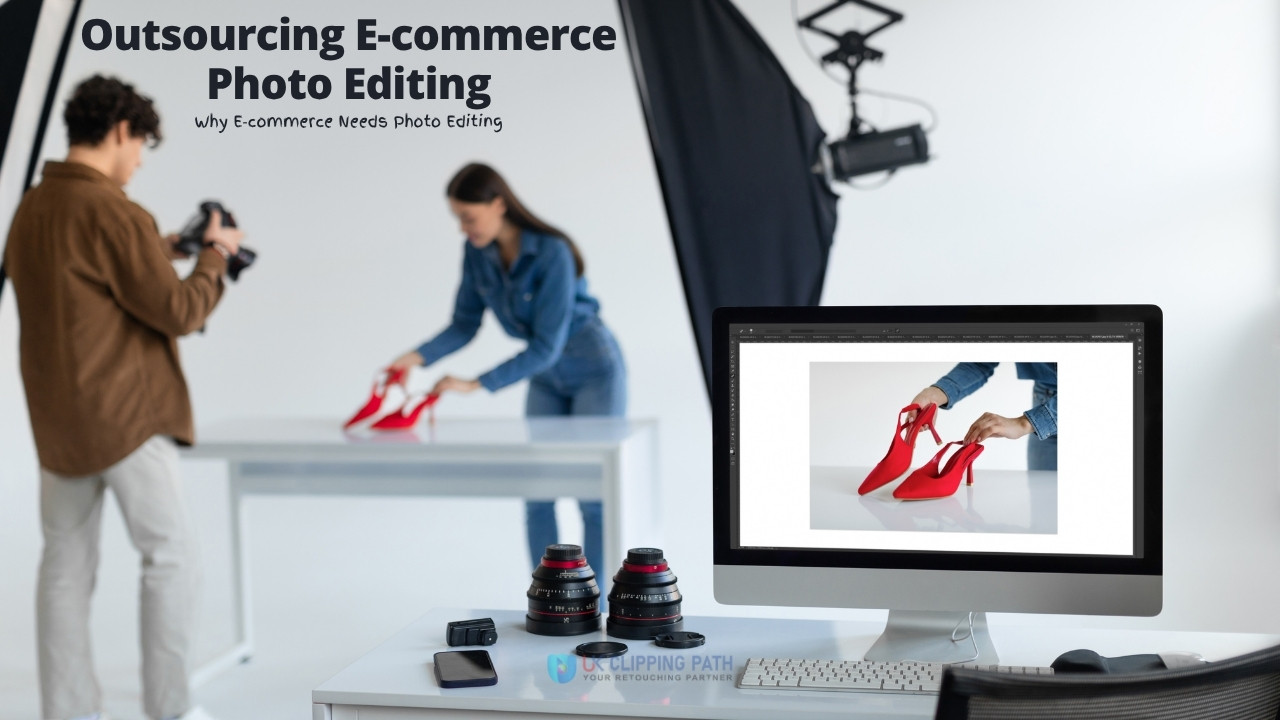
Outsourcing ecommerce photo editing can help online retailers publish products faster, reduce permanent staffing costs, maintain consistent catalogue standards and manage seasonal image volumes without expanding an internal team.
It works best when editing has become a repeatable production problem. The results still depend on the provider’s experience, quality control, communication, security and ability to follow brand instructions. Outsourcing should therefore be treated as a workflow and capacity decision, not simply a cheaper way to improve product images.
What Are the Main Benefits of Outsourcing Ecommerce Photo Editing Services?

The main benefits of outsourcing ecommerce photo editing services are faster turnaround, flexible capacity, lower fixed costs, consistent output and access to specialist editing skills.
| Benefit | Practical business result |
| Faster turnaround | Products can be prepared and published sooner |
| Flexible capacity | Bulk and seasonal projects can be handled without permanent hiring |
| Lower fixed costs | Fewer staffing, training, software and workstation commitments |
| Better consistency | Crops, backgrounds, shadows and dimensions follow one standard |
| Specialist skills | Complex products can be assigned to experienced editors |
| More internal focus | Teams can spend more time on photography, listings and launches |
These benefits are not automatic. A provider still needs clear instructions, realistic deadlines and a dependable photo editing quality control process.
When Does Outsourcing Make Sense for an Ecommerce Business?
Outsourcing makes sense when image volume, editing complexity or publishing deadlines exceed what the internal team can manage reliably.
Common warning signs include:
- Product uploads are regularly delayed.
- Images remain in an editing queue for several days.
- Different editors produce inconsistent results.
- Photographers spend more time editing than shooting.
- Seasonal launches create sudden workload spikes.
- Marketplace images repeatedly need corrections.
- Another employee is being considered mainly for routine editing.
Small stores can also outsource ecommerce photo editing through small batches, pay-as-you-go plans or occasional launch support. The decision depends more on recurring workload and internal management time than store size alone.
In-house editing may still be better for highly creative campaigns, immediate art-direction changes or very low image volumes. A hybrid approach can also work well, with creative decisions and final approval kept in-house while routine catalogue production is outsourced.
How Does Outsourcing Speed Up Product Publishing?
Outsourcing speeds up product publishing by allowing image editing to continue while internal teams work on descriptions, inventory, photography and merchandising.
A typical workflow may look like this:
Photography > File organisation > Outsourced editing > Internal review > Product upload
Instead of waiting for one person to complete every stage, an external team may process several batches at the same time. Time-zone differences can sometimes support overnight delivery, but working hours, handoff times and review procedures should be confirmed first.
Actual turnaround depends on image count, file quality, product type, editing complexity, required versions and revision expectations. Basic background removal services will usually take less time than detailed jewellery retouching, transparent-product masking or complex furniture editing.
Can Outsourcing Reduce Ecommerce Photo Editing Costs?
Outsourcing can reduce ecommerce photo editing costs when it removes the need to recruit, train and equip additional full-time editors.
Costs that may be reduced include:
- Salaries and employee benefits
- Recruitment and onboarding
- Training and management
- Editing workstations and storage
- Photoshop or Lightroom subscriptions
- Idle staff capacity during quiet periods
However, outsourcing does not guarantee a lower total cost. It changes some permanent expenses into variable per-image or project costs.
A more useful comparison is:
Internal cost per approved image = total monthly in-house editing cost ÷ images that pass review
Outsourced cost per approved image = provider fees + revision costs + internal review time ÷ images that pass review
Approved images matter because inexpensive editing that requires repeated corrections can become costly. Retailers should also account for rush fees, complex-image charges, file-format requirements and the time employees spend reviewing delivered work.
How Does Outsourcing Improve Product Image Consistency?

Outsourcing improves product image consistency when every editor follows the same documented production standard.
That standard should define:
- Crop ratio and product alignment
- Background colour or transparency
- Shadow direction and intensity
- Retouching limits
- Colour references
- Output dimensions
- File formats
- File naming rules
Using several editors without one shared guide may create more inconsistency rather than solve it. For recurring catalogue work, ask whether the provider can assign a dedicated team and retain approved instructions for future batches.
Colour correction also requires realistic expectations. Editors can create consistent files and match supplied references, but they cannot control how colours appear on every customer’s screen. Device settings, browsers and display calibration can affect the final appearance.
Which Ecommerce Photo Editing Tasks Can Be Outsourced?
Most repeatable production edits can be outsourced, including clipping paths, background removal, retouching, colour correction, shadows, resizing and file preparation.
Clipping paths work well for products with clear edges, while image masking is often more suitable for hair, fur, soft details and transparent items. Product retouching may include dust removal, scratch cleanup, temporary crease reduction and removal of minor production distractions.
Permanent product details should not be removed in a way that misrepresents what customers will receive.
For apparel retailers, ghost mannequin editing can remove visible mannequins, join neck areas and help garments maintain a clean, consistent shape.
Files can also be cropped and resized for ecommerce platforms and marketplaces such as Shopify, Amazon, Etsy, eBay and Walmart Marketplace. Alt text, product schema and website implementation remain separate from visual image editing.
Can Outsourced Editors Handle Large Catalogues and Seasonal Peaks?
A suitable provider can support large catalogues and seasonal peaks, but retailers should verify actual capacity before relying on it.
Before a major launch, Black Friday campaign or bulk marketplace upload, ask:
- What is the normal daily capacity?
- Does capacity change for complex images?
- Is rush or weekend delivery available?
- Must peak-season capacity be reserved?
- Is a dedicated team available?
- What happens if a deadline is missed?
Avoid vague claims about thousands of images being completed overnight. Capacity should be confirmed for the exact service, product category, image complexity and deadline.
What Are the Main Risks of Outsourcing?
The main risks are inconsistent quality, misunderstood instructions, hidden costs, security concerns, revision delays and missed deadlines.
| Risk | How to reduce it |
| Style mismatch | Use reference images, a style guide and a test batch |
| Inconsistent edits | Request central quality control and a dedicated team |
| Hidden charges | Confirm pricing, revisions and rush fees in writing |
| Security concerns | Review file access, retention and deletion procedures |
| Communication delays | Agree on response hours and a named contact |
| Missed deadlines | Confirm capacity and delivery commitments |
| Too many revisions | Give clear instructions and batch-based feedback |
Outsourcing does not mean giving up control. The retailer should still set the visual standard, define revision requirements and approve final files.
Outsourcing vs In-House Photo Editing: Which Is Better?
Outsourcing is usually better for repeatable catalogue work, changing image volumes and specialist production editing, while in-house editing is stronger for immediate creative collaboration.
An internal editor normally has closer brand familiarity and can respond quickly to daily art-direction changes. The disadvantages are fixed staffing costs and limited capacity during busy periods.
An external provider offers flexible capacity and broader technical skills, but the relationship requires clear instructions and reliable communication.
For many retailers, a hybrid model works best:
- Keep art direction and hero-image editing in-house.
- Outsource routine catalogue production.
- Use external capacity during seasonal peaks.
- Keep final approval with the internal team.
This allows the business to maintain creative control while gaining the practical benefits of outsourced product image editing.
How Much Do Ecommerce Photo Editing Services Cost?
Ecommerce photo editing pricing depends on the service type, image complexity, volume, turnaround, output requirements and revision policy.
Providers may charge per image, by complexity, per project, by the hour or through a monthly package. Hair, glass, fur, reflective materials, detailed paths and multiple output versions may cost more.
Before accepting a quote, confirm:
- Minimum order requirements
- Included revision rounds
- Rush and weekend charges
- Complex-image surcharges
- Source-file or layered-file fees
- Storage and deletion terms
- Recurring-volume discounts
Price should be compared alongside quality, first-time approval rate and turnaround. The cheapest quoted price is not always the lowest real cost.
How Should You Choose an Ecommerce Photo Editing Provider?
Choose a provider by testing representative images and checking category experience, quality control, security, capacity and communication.
A useful test batch should include simple, average and difficult images, several product colours, different angles and at least one file likely to expose masking, reflection or colour problems.
Review the test based on:
- Product accuracy
- Edge quality
- Colour consistency
- Product alignment
- File naming
- Turnaround
- Communication
- Revision requirements
Ask who checks completed files, whether quality control is separate from editing and how recurring instructions are stored. Category experience also matters. A strong jewellery portfolio does not automatically prove skill in apparel, glass, electronics or furniture.
Warning signs include:
- No test process
- No written revision policy
- Vague turnaround claims
- No security explanation
- One price for every image type
- No category-specific examples
- Unclear file ownership
This guide on how to choose a photo retouching service covers further checks to make before committing to a large project.
How Should the Outsourcing Process Begin?
The outsourcing process should begin with a controlled test rather than moving an entire catalogue immediately.
A practical onboarding workflow is:
- Send representative source files.
- Share editing instructions and reference images.
- Confirm pricing, formats and turnaround.
- Review the test batch.
- Give clear, grouped feedback.
- Approve the final standard.
- Begin with a small production batch.
- Scale after quality and delivery become reliable.
Revision terms should also be agreed in advance. Confirm how many revision rounds are included, what counts as a new request and how quickly corrections will be returned.
How Can You Measure Whether Outsourcing Is Working?
Outsourcing should be measured through quality, cost, speed and workflow performance rather than sales alone.
Useful measures include:
- Cost per approved image
- Average turnaround time
- First-time approval rate
- Revision rate
- Missed deadlines
- Images published per week
- Internal hours saved
- Batch-to-batch consistency
Sales and conversion rates should not be the only measures because traffic, pricing, reviews, demand and merchandising also affect performance.
Frequently Asked Questions
Is outsourcing suitable for a small ecommerce business?
Yes. Small businesses can use pay-as-you-go pricing, occasional launch support or small editing batches without committing to permanent staff.
How long does outsourced ecommerce photo editing take?
Turnaround depends on image volume, product complexity, required edits, output versions and revisions. Request an estimate based on real sample files.
Can I outsource only part of the editing workflow?
Yes. Many retailers keep creative retouching and approval in-house while outsourcing routine background removal, resizing, clipping paths and bulk ecommerce photo editing.
Is it safe to send unreleased product images to an editing company?
It can be safe when the provider uses controlled file transfer, restricted access, confidentiality terms and clear retention and deletion procedures.
How should I evaluate an ecommerce photo editing free trial?
Check product accuracy, edge quality, colour, consistency, file organisation, communication, turnaround and the amount of revision work needed.
Final Decision
Outsourcing ecommerce photo editing is worth considering when editing delays product publishing, creates unstable staffing needs or requires specialist skills that are difficult to maintain internally.
It works best when the business has recurring image volume, clear visual standards and someone available to review completed work. In-house editing may remain better for extremely low volume or creative projects that require constant art-direction changes.
A hybrid model is often the right choice when a retailer needs both brand control and flexible production capacity.
The safest way to decide is to send a representative test batch containing simple, average and complex images. Compare accuracy, consistency, turnaround, communication, security and revision needs before moving an entire catalogue.