


Choosing the best image size for e-commerce can directly impact how customers interact with your online store. From product clarity to page loading speed, image sizing plays a key role in building trust and improving user experience. When images are properly optimized, shoppers stay longer and feel more confident while browsing.
For competitive US e-commerce markets, balancing visual quality and performance is essential. The right image sizes help improve SEO rankings, reduce bounce rates, and increase conversions by making your store faster and more reliable across all devices. The best image size for e-commerce depends on usage, but standard optimized dimensions ensure the best balance between speed and quality.
Why Image Size Matters in E-commerce?
The size of an image is really important. It is not only about how it looks. It also affects how well a website works, how easy it is to find and how money it makes. Below are a few reasons why image size matters in e-commerce.
Faster website loading means more conversion
Big image files make a website load slowly. If it takes a few seconds people will get frustrated and leave. They do not like to wait.
It helps with search results
Google likes websites that load fast. If you make sure your images are the size your website will be better at search results. This means people will see your website when they search for something.
Makes it easier for people to use your website
When images are clear and the right size people can understand what they are looking at. This is especially important for things, like clothes, electronics and home items.
Helps people trust your brand
When your website looks neat and tidy people think you are a company. If your images are not the size it can make your products look bad even if they are really good.
You can also learn more about eCommerce photo editing and how professionally edited product images can help build trust in your brand.
Best Image Size for E-commerce (Quick Reference Table)
To simplify things, here’s a practical breakdown of standard sizes used across most e-commerce platforms.
| Image Type | Recommended Size | Purpose |
| Product Thumbnail | 200 × 200 px | Category preview |
| Main Product Image | 800 × 800 px | Product display page |
| Zoom / High-Resolution | 1500–2500 px | Detailed inspection |
| Banner Image | 1920 × 600 px | Homepage & promotions |
This structure reflects the most commonly used ecommerce product image size standards across modern stores.
Consistency matters more than perfection. Keeping a fixed ratio across all images improves both design flow and product image sizing for ecommerce performance.
Best Image Size for Shopify, Amazon and WooCommerce
Different platforms have different requirements for images and if you do not follow them the images will not look as good as they should.
Shopify Image Size
- The ideal size for a Shopify image is 2048 × 2048 pixels.
- The recommended ratio for Shopify images is 1:1 square.
- The best format for Shopify images is JPEG or WebP.
Shopify will automatically make your images smaller. If you upload images that are already optimized they will look better. This is usually considered the image size for Shopify stores.
WooCommerce Image Size
The size for a WooCommerce image is 800 × 800 pixels. However this depends on the settings of your theme. WooCommerce images can be scaled to fit screens.
If you upload images that are all different sizes it can be hard to get them to line up properly on the page. This is why a lot of sellers like to use WooCommerce product image size settings to make sure everything looks uniform.
Amazon Product Image Size
The size for an Amazon product image is 1000 × 1000 pixels. It is recommended that you use an image that’s 1600 × 1600 pixels or bigger. The image also needs to have a background.
Amazon is very particular about how images are displayed when you zoom in so using the correct Amazon product image size is important if you want your images to be approved and look good.
Image Formats for E-commerce Websites
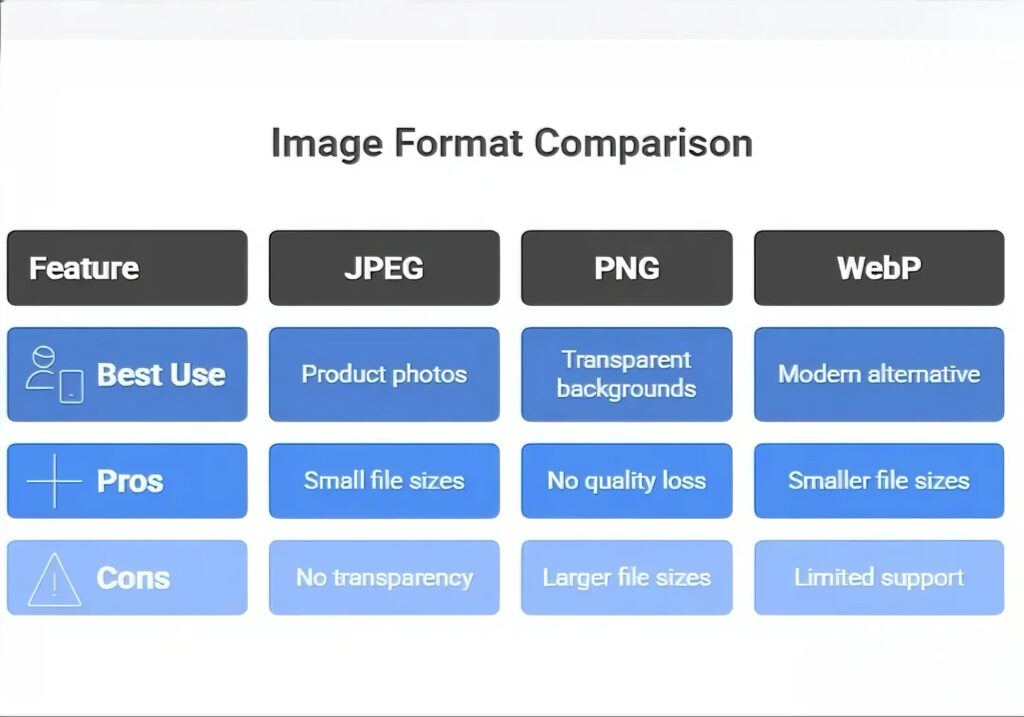
When you are making a website for your store you need to think about the kind of picture format you will use. Choosing the format is just as important as the size of the picture.
JPEG
This format is really good for taking pictures of the products you are selling. The file size is small which is great. It is okay if the picture is not totally perfect, a little quality loss is fine.
PNG
This format is really good for pictures that have backgrounds. You can have high-quality pictures with this format. The file size is bigger which is not so great.
WebP
This is a good format to use nowadays. It is smaller than JPEG and PNG which’s awesome. It is really good, for making your website load fast and for search engine optimization.
The WebP format is now used a lot in ecommerce image optimization strategies because the WebP format reduces the time it takes for your website to load without making the pictures look bad.
How to Optimize E-commerce Product Images?
Optimizing e-commerce product images is really important for your store. This is where most stores either do well or do poorly. To optimize your e-commerce product images you should follow these steps:
- Compress your images properly. You can use tools like TinyPNG or Squoosh to make your images smaller without making them look bad. This helps your website load faster.
- Use simple and clean file names for your images. For example of naming your image “IMG_123.jpg” you can name it “red-leather-wallet.jpg” or “nike-running-shoes.jpg”. This helps search engines like Google understand what your image is about. It improves your image search engine optimization.
- Add text to your images. This makes your website more accessible to people who cannot see images. It also helps your images show up in Google Images.
- Use images that can be seen clearly on screens. A lot of people shop on their smartphones so you want to make sure your images look good on these devices.
- Optimize your images before you upload them to your website. Editing your images before you upload them can make a difference. Some companies use photo retouching services to make their product images look clean and nice. Optimizing your e-commerce product images can really help your online store do well.
Common Mistakes in E-commerce Image Sizing
Even experienced store owners make these mistakes:
- Uploading oversized images (slows site speed)
- Using inconsistent ratios across products
- Ignoring mobile optimization
- Not compressing images before upload
- Using low-quality product photography
Avoiding these mistakes improves both website product image size performance and customer trust.
Best Practices for Product Photography and Image Usage
A plan for pictures is not just about making things smaller. It is about doing things the same way every time.
- You should have the shape for all your pictures, like a square.
- Use backgrounds so people look at the product.
- Make sure the light is the same in all your pictures.
- Trying to keep the picture file under 200KB is good.
- Make all your product pictures look the same.
For companies that sell clothes using a service, like ghost mannequin service can help make your Product Photography look clean and professional without anything getting in the way of the product.
Why Image Compression is Really Important for E-commerce?
Big files make pages load slowly especially when you are using a phone. When you compress images for ecommerce the way you get:
- Faster page speed
- Bounce rate
- Better Google ranking
- Improved shopping experience
Compressing images is one of the things you can do to make your website better and it makes a big difference. Image compression for ecommerce is something that can really help your website.
Product Photography Size Guidelines (Quick Recap)
To maintain consistency across your store:
- Thumbnails: 200 × 200 px
- Product pages: 800 × 800 px
- Zoom images: 1500 px and above
- Banners: 1920 × 600 px
These guidelines ensure your store remains visually clean and technically optimized.
Frequently Asked Questions (FAQs)
Here are some frequently asked questions about e-commerce image optimization that go beyond basic sizing and help improve performance, SEO, and conversions.
What is lazy loading in e-commerce images?
Lazy loading delays image loading until users scroll near them, improving page speed and reducing initial server load significantly overall.
How do responsive images improve ecommerce performance?
Srcset allows browsers to choose appropriate image sizes based on device, improving speed, responsiveness, and overall mobile user experience quality.
Should product images support retina displays?
Yes, retina-ready images ensure sharp visuals on high-DPI screens, enhancing product clarity and increasing customer trust and engagement significantly overall.
How does image cropping strategy impact conversions?
Consistent cropping focuses attention on product details, creates visual harmony, and helps users compare products more effectively during browsing experience.
Do image variations for products improve SEO and sales?
Multiple image angles improve engagement, reduce hesitation, enhance SEO visibility, and help customers make faster purchasing decisions online significantly overall.
Final Words
Getting the best image size for e-commerce is more than a technical setup, it’s a foundation for how your store performs and how customers feel while shopping. Well-optimized images create a smoother browsing experience, improve page speed, and help your products stand out in a crowded marketplace.
When you combine the right dimensions with proper formats like WebP and consistent optimization practices, your store becomes faster, cleaner, and more search-friendly. This directly supports better rankings, lower bounce rates, and higher conversions across all devices.
No matter whether you’re using Shopify, WooCommerce, or Amazon, a smart image strategy ensures your products are not only visible but also persuasive enough to drive sales consistently.